
One of the most common mistakes made by entrepreneurs launching a perfume brand is thinking about pricing too late in the process.
After spending months developing a fragrance, designing the packaging, and preparing production, they finally calculate how much the product will cost. At that point, many brands discover an uncomfortable reality: the final cost is much higher than expected, and the margins required to sell through certain channels simply do not exist.
This problem usually occurs because the project has been built from the product toward the market, when it should be done the other way around.
The reality is that the price of a perfume should not be a consequence of product development. It should be one of the first elements defined within the business strategy.
Pricing influences virtually every decision that follows:
- Fragrance quality.
- Packaging selection.
- Bottle design.
- Production volumes.
- Distribution channels.
- Marketing investments.
- Long-term profitability.
For this reason, successful perfume brands typically develop their product, positioning, and financial strategy simultaneously.
In this article, we will explore how to build a profitable perfume pricing strategy, what margins a fragrance brand truly needs to remain sustainable, and how packaging can significantly impact the final cost of a premium perfume.
Why Pricing Strategy Should Be Defined Before Fragrance Development
Many brands begin by creating their dream fragrance without having a clear idea of the retail price they intend to charge.
Although it may seem logical to focus on the product first, this approach often creates significant financial challenges later in the project.
The Most Common Mistake New Perfume Brands Make
A typical scenario looks something like this:
An entrepreneur develops an exclusive fragrance.
They select a custom bottle.
They design a premium box with multiple finishes.
They manufacture an initial production run.
Only then do they calculate the total cost.
At that moment, they discover that the price required to generate profit is far higher than what the market is willing to pay.
As a result, they are forced to:
- Reduce margins.
- Cut marketing budgets.
- Change materials.
- Renegotiate suppliers.
- Reconsider their positioning strategy.
Most of these issues could have been avoided by defining the financial model from the beginning.
Designing the Product First and Calculating the Price Later
Many companies follow a seemingly reasonable logic:
“Let’s create the best perfume possible and then we’ll see how much it costs.”
The problem is that the market does not necessarily reward the most expensive product.
What truly matters is the relationship between:
- Perceived value.
- Brand positioning.
- Retail price.
- Profitability.
A fragrance may contain exceptional ingredients and luxurious packaging, but if the target customer does not perceive enough value to justify the price, the strategy is unlikely to succeed.
This is why profitable brands often begin with a different question:
“What is the ideal price range for our target customer?”
Once they have the answer, they build the entire project around it.
How Pricing Influences Every Other Decision
Pricing strategy acts as a framework that guides the entire development process.
For example, a brand planning to sell perfumes at €40 will face very different requirements from a brand targeting a retail price above €150.
Pricing directly affects:
The Formula
It determines how much budget is available for fragrance oils, raw materials, and concentration levels.
The Bottle
It influences the type of bottle, cap, and decorative finishes that can realistically be included.
The Packaging
It establishes the level of sophistication that is economically viable.
Distribution
It determines the margins that can be offered to distributors and retailers.
Marketing
It influences how much can be invested in customer acquisition and brand awareness.
For this reason, pricing strategy should be developed before the first fragrance sample is even approved.
What Determines the Final Price of a Perfume?
Many entrepreneurs assume that perfume pricing depends primarily on the fragrance itself.
In reality, the situation is far more complex.
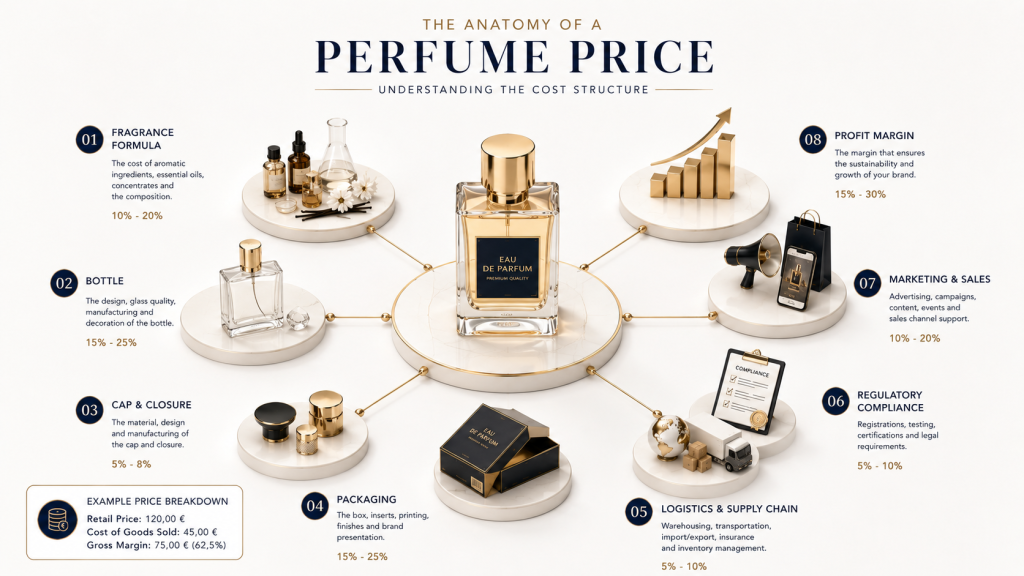
The final retail price is the result of multiple interconnected factors.
Understanding this structure is essential for building a sustainable pricing strategy.
Formula Costs
The fragrance composition represents only one part of the total product cost.
The difference between a basic formula and a highly sophisticated composition can be substantial, particularly when natural ingredients or exclusive raw materials are involved.
Factors that influence formula costs include:
- Ingredient quality.
- Fragrance concentration.
- Formula complexity.
- Raw material availability.
- Ingredient exclusivity.
However, even in premium products, the fragrance formula often represents a smaller portion of the final retail price than most consumers imagine.
Alcohol and Auxiliary Raw Material Costs
In addition to the fragrance oil, production requires several essential supporting ingredients.
These typically include:
- Cosmetic-grade alcohol.
- Purified water.
- Stabilizers.
- Technical additives.
While these costs may seem relatively minor on a per-unit basis, they become increasingly significant as production volumes grow.
Bottle Costs
The bottle is often one of the most influential components in the cost structure.
The difference between a standard stock bottle and a fully customized design can dramatically increase investment requirements.
Key components include:
- Glass bottle.
- Cap.
- Spray pump.
- Collar.
- Decorative elements.
In addition to unit costs, brands must also consider supplier minimum order quantities.
Secondary Packaging Costs
When calculating the total cost of a perfume, many brands underestimate the impact of secondary packaging.
Yet packaging elements such as the box can represent a significant portion of the overall budget.
Common packaging expenses include:
- Cardboard materials.
- Printing.
- Foil stamping.
- Embossing.
- Laminations.
- Special finishes.
In some premium projects, secondary packaging can cost more than the fragrance itself.
Regulatory and Documentation Costs
Every perfume sold legally must comply with various regulatory requirements.
These costs may include:
- Safety assessments.
- Technical documentation.
- Certifications.
- Product registrations.
- Market-specific compliance adaptations.
Although these are often treated as one-time expenses, they are part of the investment required to launch a brand.
Logistics Costs
Logistics is another factor frequently overlooked during the planning stage.
Expenses may include:
- Component transportation.
- Warehousing.
- Handling.
- Distribution.
- Direct-to-consumer shipping.
Heavy bottles or complex packaging designs can significantly increase logistics costs.
Marketing and Customer Acquisition
A perfume does not sell simply because it exists.
It needs visibility.
And visibility comes at a cost.
Typical investments include:
- Social media marketing.
- Digital advertising.
- Influencer campaigns.
- Public relations.
- Content creation.
- Email marketing.
For many Direct-to-Consumer brands, customer acquisition costs represent one of the largest expenses within the business model.
How to Build a Profitable Perfume Pricing Strategy
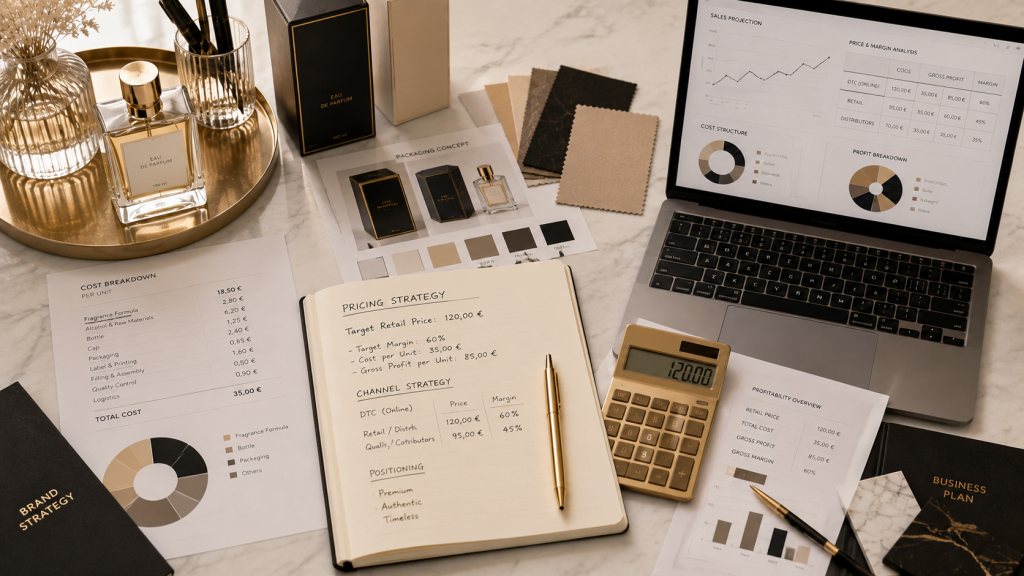
Setting a price is not simply a matter of adding a markup to production costs.
The most successful fragrance brands combine several methodologies to build sustainable pricing models.
Cost-Based Pricing
This is the simplest and most common approach among new businesses.
It involves calculating the total product cost and adding a desired margin.
While useful as a starting point, this method has a significant limitation.
The market may not be willing to pay the price required to achieve the company’s financial objectives.
For this reason, cost-based pricing should rarely be used in isolation.
Value-Based Pricing
In the fragrance industry, perceived value often matters more than manufacturing cost.
Consumers are not simply buying ingredients and materials.
They are buying:
- Image.
- Exclusivity.
- Experience.
- Storytelling.
- Prestige.
Two perfumes with similar production costs may sell at dramatically different prices depending on the value consumers perceive.
Premium fragrance brands often build much of their pricing strategy around this principle.
Positioning-Based Pricing
Brand positioning also plays a major role in pricing decisions.
A fragrance intended to compete in the luxury segment cannot use the same pricing approach as a mass-market product.
Price acts as a signal.
It communicates quality, exclusivity, and status.
As a result, setting a price too low can actually damage the perception of an otherwise excellent product.
Channel-Based Pricing
Finally, distribution strategy must be integrated into the pricing model.
Selling:
- Direct-to-consumer.
- Through retailers.
- Through international distributors.
- On marketplaces.
Each channel requires a completely different margin structure.
Brands that ignore this reality often discover too late that their business model is not financially sustainable.
What Margins Does a Perfume Brand Really Need?
One of the most important questions before launching a fragrance brand is:
How much margin is required to make the business profitable?
The answer depends on several variables, but understanding margins is essential before starting any project.
Many entrepreneurs confuse revenue with profitability.
However, generating sales does not automatically generate profit.
In fact, many perfume brands increase revenue while continuing to lose money.
To avoid this situation, it is essential to understand how margins work within the fragrance industry.
Gross Margin vs. Net Profit
Before analyzing how much margin a perfume brand needs, it is important to understand a fundamental distinction.
Gross margin and net profit are not the same thing.
Gross margin represents the difference between the selling price and the direct cost of the product.
For example, if a perfume costs €15 to manufacture and sells for €75, the gross margin may initially appear very attractive.
However, that margin must still cover:
- Marketing.
- Logistics.
- Warehousing.
- Salaries.
- Product development.
- Customer service.
- Payment processing fees.
- Administrative expenses.
Once these costs have been deducted, the net profit is often significantly lower.
This is why many apparently profitable fragrance brands begin facing financial challenges when they start scaling their operations.
Minimum Margin for a DTC Perfume Brand
Direct-to-Consumer (DTC) brands benefit from eliminating intermediaries.
This allows them to retain a larger portion of the retail price.
However, they must also assume full responsibility for customer acquisition.
In many cases, the cost of acquiring a customer represents a significant percentage of the final selling price.
For this reason, DTC fragrance brands typically require strong gross margins to sustain growth.
Beyond manufacturing costs, they must fund:
- Digital advertising.
- Content creation.
- Social media management.
- Influencer campaigns.
- Email marketing.
- Customer retention programs.
An insufficient margin structure quickly limits a brand’s ability to scale.
Margin Requirements for Retail Distribution
Traditional retail presents a completely different scenario.
When a perfume is sold through retailers, a portion of the margin must be shared among distributors, wholesalers, and retail partners.
Every participant in the supply chain needs to generate profit.
As a result, brands planning to enter retail channels must build their cost structure with this reality in mind from the very beginning.
One of the most common mistakes is developing a product with costs that are simply too high to support the margin structure required by retail distribution.
The result is often either reduced profitability or an inability to access key sales channels.
Margins for International Distributors
International expansion introduces additional layers of complexity.
Beyond standard commercial margins, brands may encounter costs related to:
- Importation.
- International logistics.
- Regulatory adaptations.
- Local distribution.
- Commercial representation.
Brands planning to sell across multiple countries should consider these factors during the initial planning phase.
Designing a product exclusively for a local market can make future international expansion far more difficult.
Why Many Perfume Brands Generate Sales but Not Profit
One of the most common phenomena in the fragrance industry is the confusion between growth and profitability.
Some brands succeed in generating impressive sales volumes.
However, when they analyze their financial performance, they discover that profits remain disappointingly low.
This usually happens because of factors such as:
- Insufficient margins.
- Excessive customer acquisition costs.
- Overengineered packaging.
- Aggressive discounting.
- Poor logistics planning.
Profitability must be designed into the business model from the beginning rather than corrected after launch.
A Practical Example of Margin Structures
Although every project is different, understanding how a perfume’s retail price is typically distributed can be extremely useful.
Perfume Sold Online
In a typical DTC model, the retail price must cover:
- Manufacturing costs.
- Marketing expenses.
- Logistics.
- Operations.
- Business profit.
The main advantage is that the brand retains greater control over margins.
However, it also assumes all commercial risk.
Perfume Sold Through Retail
When retailers become involved, the economics change significantly.
The final retail price must generate profit for every participant in the value chain.
As a result, manufacturing costs generally represent a smaller percentage of the final retail price.
Brands planning to enter retail should carefully design their cost structure from the earliest stages of development.
Perfume Sold Through Distributors
International distribution often requires an even more complex margin structure.
The chain may include:
- Manufacturer.
- Brand owner.
- Distributor.
- Importer.
- Retailer.
Each participant adds costs and profitability expectations.
For this reason, a strong perfume pricing strategy is essential to remain competitive while protecting profit margins.
How Packaging Impacts the Final Cost of a Premium Fragrance
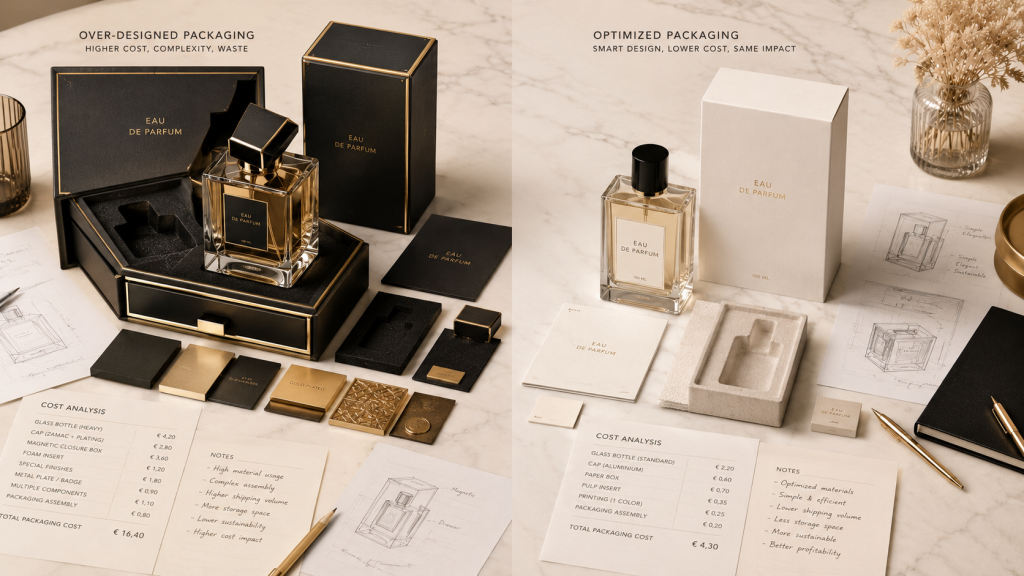
One of the most underestimated aspects of launching a perfume brand is the financial impact of packaging.
Many entrepreneurs are surprised to discover that packaging can represent a substantial percentage of the total product cost.
In some premium projects, the complete packaging system can even cost more than the fragrance itself.
Packaging as a Strategic Asset
Packaging is not merely an aesthetic consideration.
It directly influences:
- Brand positioning.
- Perceived value.
- Customer experience.
- Manufacturing costs.
- Logistics expenses.
A spectacular design may increase brand appeal, but it can also quickly erode profitability if not managed carefully.
Bottle Costs
The bottle is often one of the most significant cost drivers within the project.
Cost differences can vary dramatically depending on factors such as:
- Custom bottle design.
- Glass thickness.
- Color treatments.
- Special finishes.
- Minimum production quantities.
For many emerging brands, stock bottles provide an excellent balance between premium appearance and financial efficiency.
Cap Costs
The cap is one of the elements that most strongly influences perceived quality.
However, it can also become a major source of additional costs.
Materials such as:
- Metal.
- Wood.
- Specialty resins.
- Magnetic components.
Can significantly increase overall investment.
For this reason, brands should carefully evaluate whether these upgrades deliver meaningful returns.
Decoration Costs
Bottle decoration includes elements such as:
- Silk-screen printing.
- Hot stamping.
- Embossing.
- Metallic finishes.
- Special decorative treatments.
While these enhancements can improve premium perception, each additional detail increases the unit cost.
The challenge lies in balancing visual impact with profitability.
Box Costs
The outer box is one of the most visible elements from the consumer’s perspective.
However, it can also become one of the largest cost generators.
Factors such as:
- Premium board materials.
- Complex closure systems.
- Specialty finishes.
- Interior inserts.
- Advanced printing techniques.
Can quickly multiply packaging expenses.
Premium Finishes and Customization
Customization is a powerful differentiation tool.
However, it often involves:
- High minimum order quantities.
- Development costs.
- Longer lead times.
- Reduced operational flexibility.
For this reason, many brands initially choose semi-custom solutions that combine differentiation with financial efficiency.
The Most Expensive Mistakes in Perfume Packaging Costs
Over the years, many fragrance brands have made similar packaging-related mistakes.
Understanding them can help entrepreneurs avoid unnecessary expenses.
Overdesigning the Packaging
One of the most common mistakes is investing heavily in features that have little influence on purchasing decisions.
More complex packaging does not always generate more sales.
Choosing Components with Excessively High MOQs
Some suppliers require very large minimum order quantities.
This can tie up significant amounts of capital and increase financial risk.
Customizing Too Early
New brands are often attracted to fully custom packaging solutions.
However, it is usually wiser to validate market demand before making major investments in bespoke designs.
Ignoring Logistics Costs
Heavy or oversized packaging increases:
- Transportation expenses.
- Warehousing costs.
- Distribution costs.
- E-commerce fulfillment costs.
These factors are frequently overlooked during the planning stage.
How to Balance Premium Image and Profitability
The most successful fragrance brands understand that profitability is not simply about reducing costs.
It is about investing intelligently.
Where to Invest
Generally, it makes sense to invest in areas that customers clearly perceive.
Examples include:
- Packaging quality.
- Unboxing experience.
- Brand identity.
- Product photography.
- Marketing communication.
These elements often have a direct impact on perceived value.
Where to Save
Conversely, there are areas where costs can be optimized without significantly affecting the customer experience.
The key is identifying which investments genuinely create value and which simply add expense.
What Consumers Actually Notice
There is often a substantial difference between what brands consider valuable and what customers truly appreciate.
Understanding this distinction leads to more profitable decision-making.
Optimizing Costs Without Reducing Perceived Value
The most efficient brands deliver a premium experience without incurring excessive costs.
This is typically achieved through:
- Intelligent material selection.
- Component simplification.
- Logistics optimization.
- Strategic design decisions.
How Cost Structures Change Depending on Positioning
Not every fragrance brand requires the same economic model.
Niche Perfumery
Differentiation often justifies higher investments in creativity, exclusivity, and storytelling.
Luxury Fragrances
Packaging, experience, and brand perception become critical cost drivers.
Sustainable Fragrances
A larger portion of the budget may be allocated to responsible materials and transparent production processes.
Direct-to-Consumer Brands
Customer acquisition and digital marketing often represent a significant percentage of total expenses.
Retail-Oriented Brands
Cost structures must support healthy margins for every participant within the distribution chain.
Questions You Should Answer Before Pricing Your Perfume
Before approving any fragrance development project, it is worth answering the following questions:
What Is My Primary Sales Channel?
What Margin Do I Need to Grow?
What Is My Brand Positioning?
How Much Will I Need to Invest in Marketing?
What Price Is My Target Customer Willing to Pay?
Will My Cost Structure Remain Profitable as Volume Increases?
The answers to these questions form the foundation of a sustainable pricing strategy.
Conclusion
Pricing a perfume should never be an afterthought. In reality, it is one of the most important strategic decisions involved in building a fragrance brand.
Pricing influences formulation choices, packaging decisions, distribution opportunities, commercial strategy, and ultimately the long-term profitability of the business. Likewise, understanding the margin requirements of each sales channel helps brands avoid costly mistakes that could limit future growth.
Packaging also plays a critical role. It can become a powerful tool for differentiation and positioning, but it can also generate unnecessary costs when not managed strategically.
The most successful perfume brands do not develop a product first and then attempt to make it profitable. They design the product, pricing model, distribution strategy, and cost structure simultaneously to build sustainable businesses from day one.
At MS Parfum Lab, we help entrepreneurs, startups, and established companies develop profitable fragrance brands from the earliest stages of the project. Our team works alongside clients to define pricing strategy, fragrance development, packaging solutions, and manufacturing processes that create a strong financial foundation for long-term growth.