
One of the most common mistakes entrepreneurs make when launching a perfume brand is starting with the fragrance itself. They spend weeks or even months working on scent profiles, selecting raw materials, and designing packaging without first answering a far more important question:
How will this perfume actually be sold?
Most perfume brands do not fail because they have a bad fragrance. They fail because they develop a product without a clear market strategy. In other words, they create the perfume before defining who will buy it, where they will buy it, and why they should choose it over hundreds of competing alternatives.
In the fragrance industry, distribution strategy and brand positioning are inseparable. The sales channel influences critical aspects such as pricing, packaging, production volumes, commercial margins, and even the fragrance development process itself.
For this reason, before investing in perfume formulation, it is essential to establish a solid commercial strategy. Understanding how the market behaves, identifying opportunities, and selecting the right distribution channel can make the difference between a brand that grows sustainably and one that disappears shortly after launch.
In this article, we will explore why your perfume distribution strategy should be defined before product development and how to identify a genuine market opportunity for your fragrance brand.
Why Your Distribution Strategy Should Be Defined Before Creating the Perfume
When companies develop a new product, there is often a tendency to focus exclusively on its features. In perfumery, this usually means obsessing over fragrance notes, formulation details, and packaging aesthetics.
However, consumers do not simply buy perfume.
They buy an experience.
They buy a story.
They buy an identity.
They buy a value proposition.
Before designing any product, it is crucial to understand how it will reach the final customer.
The Most Common Mistake New Perfume Brands Make
Many new fragrance brands follow a similar process:
First, they develop a fragrance.
Then, they design the packaging.
Next, they manufacture an initial production run.
Only afterward do they begin asking how they are going to sell it.
The problem is that by that stage, many key decisions are already difficult and expensive to change.
It is common to discover that:
- Manufacturing costs are too high for the chosen sales channel.
- The packaging does not match customer expectations.
- Commercial margins are insufficient for distributors.
- The fragrance does not align with consumer preferences within the selected market segment.
Most of these issues could have been avoided if the commercial strategy had been defined from the beginning.
Product-First Thinking vs Market-First Thinking
Successful perfume brands usually take a completely different approach.
Instead of asking:
“What perfume do we want to create?”
They ask:
“What opportunity exists in the market?”
This may seem like a subtle difference, but it fundamentally changes the entire development process.
When brands analyze the market first, they can identify:
- Unmet consumer needs.
- High-potential market segments.
- Emerging trends.
- Distribution channels with less competition.
- Customers willing to pay premium prices.
Only after identifying these opportunities do they begin developing products specifically designed to serve them.
How the Sales Channel Influences Every Business Decision
Distribution is not a tactical decision made at the end of the process.
It is a strategic decision that influences nearly every aspect of the business.
Pricing
Different channels have different pricing expectations.
A perfume sold exclusively online can operate with significantly different margins than one distributed through wholesalers, retailers, and department stores.
Packaging
Consumer expectations vary greatly depending on the point of sale.
A fragrance intended for a luxury boutique must communicate exclusivity from the very first glance.
A product designed primarily for e-commerce may need to focus more heavily on unboxing experiences, durability during shipping, and digital presentation.
Production Volumes
Some channels require substantial initial inventory, while others allow brands to grow progressively.
This directly impacts the level of investment required to launch the business.
Marketing
Customer acquisition strategies differ dramatically between online and offline distribution models.
As a result, marketing budgets should be considered from the very beginning of the project.
The Main Sales Channels for a Perfume Brand
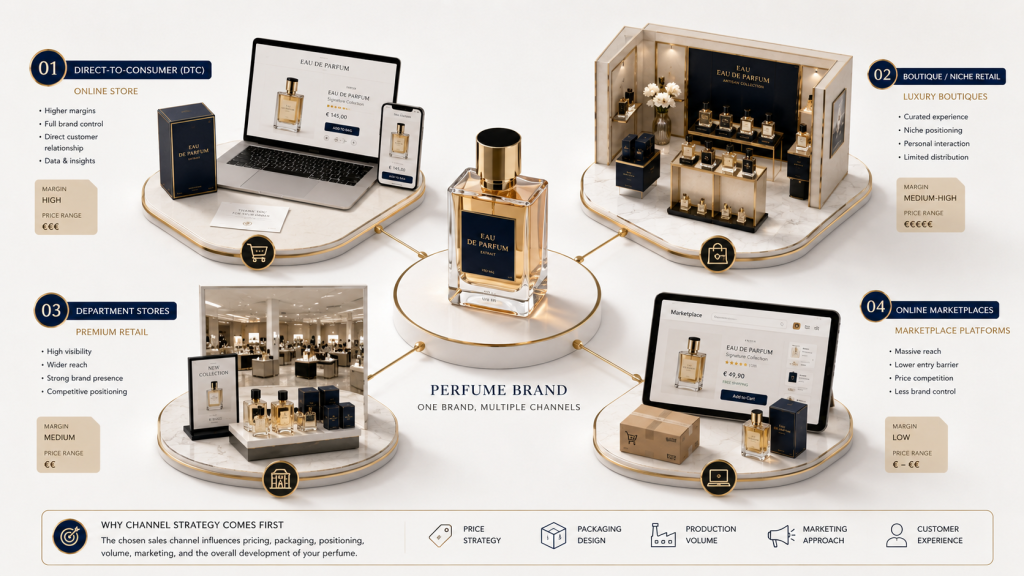
There is no single perfect sales channel for every fragrance brand.
Each model offers distinct advantages, challenges, and operational requirements.
Understanding these differences helps brands make more informed decisions during product development.
Direct-to-Consumer (DTC)
The Direct-to-Consumer model has transformed countless industries, and perfumery is no exception.
An increasing number of fragrance brands now sell directly to customers through their own digital platforms.
The advantages are obvious:
- Greater control over the brand.
- Higher profit margins.
- Direct customer relationships.
- Greater commercial flexibility.
However, there are also significant challenges.
Brands must take full responsibility for customer acquisition, logistics, fulfillment, and after-sales support.
Furthermore, competing for consumer attention online can be expensive.
For this reason, successful DTC perfume brands typically invest heavily in branding, storytelling, and digital marketing.
Retail Distribution
Traditional retail remains one of the most important growth channels for fragrance brands.
This category includes:
- Independent perfume stores.
- Beauty chains.
- Department stores.
- Multi-brand retailers.
The primary advantage is access to large numbers of potential customers.
However, retail distribution also brings higher commercial expectations.
Retailers and distributors expect:
- Competitive margins.
- Reliable supply chains.
- Professional sales support.
- Consistent product availability.
Brands planning to enter retail should structure their pricing and production models accordingly from the outset.
Niche Perfumery
Niche fragrance has experienced significant growth over the past decade.
Consumers increasingly seek exclusive products, authentic stories, and differentiated experiences.
Specialized boutiques and concept stores often prefer brands with highly distinctive identities.
Within this environment, differentiation matters far more than volume.
The fragrance, packaging, storytelling, and customer experience must work together to create a compelling and unique proposition.
Marketplaces
Platforms such as Amazon and specialized beauty marketplaces offer quick access to large audiences.
However, they also introduce unique challenges.
Competition is often intense, and pricing pressure can reduce profitability.
In addition, it is more difficult to establish a direct relationship with customers.
For this reason, many brands use marketplaces as a complementary channel rather than their primary sales strategy.
Hybrid Distribution Models
In practice, many successful perfume companies combine several channels.
For example:
- Their own e-commerce store.
- Selective distributors.
- Marketplaces.
- Physical retail partners.
This approach helps diversify risk and expand market reach.
However, it also requires a carefully coordinated strategy to avoid channel conflicts and pricing inconsistencies.
How Distribution Influences Perfume Development
Once a primary sales channel has been selected, it becomes much easier to make informed product development decisions.
Pricing Strategy
The final retail price should not be based solely on manufacturing costs.
It must also account for:
- Manufacturer margins.
- Distributor margins.
- Logistics costs.
- Marketing investment.
- Business profitability goals.
Many brands discover too late that their cost structure is incompatible with their chosen distribution model.
Required Commercial Margins
Different channels require different profitability levels.
A DTC business model allows brands to retain higher margins.
Traditional retail distribution requires sharing a significant portion of revenue with intermediaries.
This directly influences decisions regarding formulation, materials, packaging, and production methods.
Packaging Design
Packaging does more than communicate brand values.
It must also satisfy specific commercial requirements.
For example, a perfume designed primarily for e-commerce must withstand transportation while delivering an exceptional unboxing experience.
A fragrance intended for physical retail, on the other hand, must stand out visually on store shelves and immediately attract consumer attention.
Product Sizes and Formats
Distribution strategy can also influence packaging formats.
Certain channels perform better with travel sizes, discovery sets, or sample kits.
Others may favor premium full-size bottles.
Selecting the appropriate format from the beginning helps optimize costs while improving commercial performance.
What Is Fragrance Positioning?
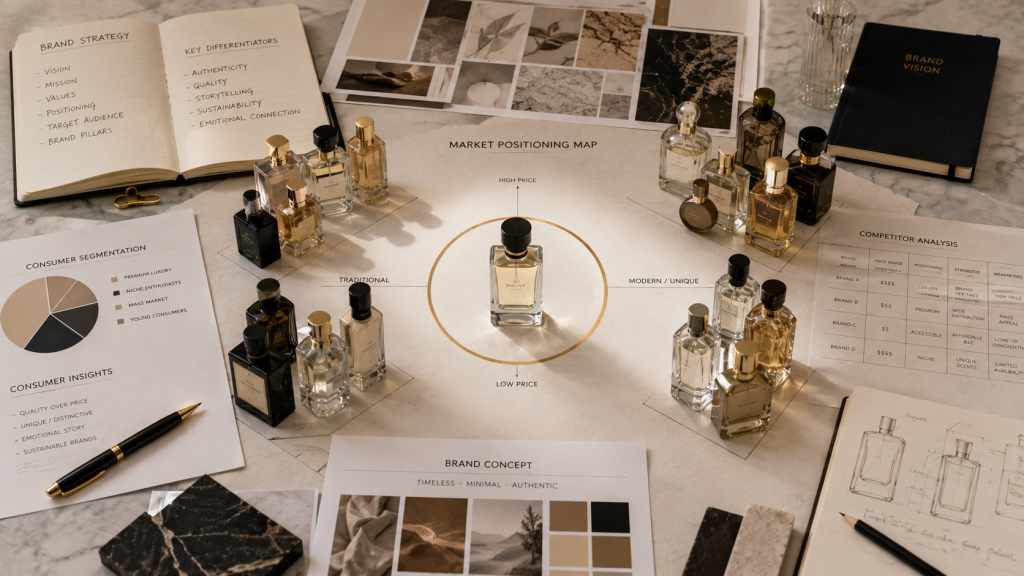
Once the sales channel has been defined, it is time to answer another critical question:
What place will your brand occupy in the consumer’s mind?
This is the essence of fragrance positioning.
Many entrepreneurs assume that positioning simply means deciding whether a perfume brand will be premium, affordable, or luxury. In reality, positioning goes much deeper than pricing or product category.
Positioning defines how consumers perceive your brand and what makes it different from every other fragrance option available in the market.
In an industry where thousands of perfumes compete for attention, having a clear positioning strategy is often more important than the fragrance formula itself.
Defining Brand Positioning
Positioning is the mental space a brand occupies in the minds of its target audience.
It is not what the company says about itself.
It is how the market actually perceives it.
For example, two perfumes may share similar olfactory profiles and still be perceived completely differently because of their positioning.
A fragrance brand may communicate:
- Exclusivity.
- Sophistication.
- Sustainability.
- Innovation.
- Wellness.
- Minimalism.
- Craftsmanship.
- Affordable luxury.
The key is selecting a clear and consistent value proposition that consumers can easily understand and remember.
Why Positioning Matters More Than the Fragrance
This may sound controversial, but many of the world’s most successful perfume brands are not simply selling fragrances.
They are selling identities.
Consumers rarely purchase a perfume based solely on fragrance notes. Most purchasing decisions are influenced by emotional, social, and aspirational factors.
People buy products that reflect who they are—or who they aspire to become.
For this reason, two perfumes of similar quality can achieve completely different commercial results.
The difference often lies in the strength of the brand positioning.
The Difference Between a Product and a Brand
Products can be copied.
Brands are much harder to replicate.
A fragrance formula may inspire competitors, but a brand’s story, values, community, and emotional connection with consumers are far more difficult to imitate.
The most successful perfume brands invest as much effort into building their identity as they do into developing their products.
How to Find a Gap in the Perfume Market
One of the biggest strategic mistakes a new fragrance company can make is trying to compete in exactly the same space as established brands.
When a new entrant enters an overcrowded segment without meaningful differentiation, it often ends up competing primarily on price, which reduces margins and limits growth potential.
This is why identifying genuine market opportunities before developing a fragrance is so important.
Analyze Existing Competitors
The first step is understanding who already operates within your target market.
This analysis should go beyond evaluating fragrances themselves.
It should also examine:
- Brand positioning.
- Pricing strategy.
- Visual identity.
- Distribution channels.
- Marketing communication.
- Target audience.
A thorough competitive analysis often reveals underserved opportunities where customer needs are not being fully addressed.
Identify Unmet Consumer Needs
The best opportunities frequently emerge when a brand solves a problem that competitors have overlooked.
Examples include:
- Fragrances for consumers sensitive to certain ingredients.
- Fully traceable sustainable perfumes.
- Products designed for specific communities or lifestyles.
- Wellness-oriented fragrance collections.
- Highly personalized scent experiences.
Identifying these unmet needs can create powerful competitive advantages.
Monitor Emerging Trends
Consumer behavior is constantly evolving.
What seems like a niche opportunity today may become a major market segment in the coming years.
Some of the strongest trends shaping the fragrance industry include:
- Sustainability.
- Ingredient transparency.
- Emotional wellness.
- Personalization.
- Gender-neutral fragrances.
- Conscious luxury.
- Purpose-driven brands.
Companies that identify these trends early often gain a significant competitive advantage.
Look Beyond Fragrance Notes
Many startups try to differentiate themselves solely through the scent itself.
However, successful brands often create value through multiple dimensions.
Differentiation can come from:
- Brand storytelling.
- Design.
- Customer experience.
- Community building.
- Sustainability initiatives.
- Technological innovation.
- Customer service.
The strongest fragrance brands rarely rely on a single point of differentiation.
The Main Segments of the Perfume Market
Understanding how the fragrance industry is structured makes it easier to identify opportunities and develop a coherent strategy.
Luxury Fragrances
The luxury segment is typically characterized by:
- Premium pricing.
- Sophisticated packaging.
- Selective distribution.
- Aspirational marketing.
Exclusivity plays a central role in the value proposition.
Niche Perfumery
Niche fragrances prioritize creativity, authenticity, and originality.
Consumers are often looking for unique scent experiences and deeper emotional connections with brands.
Competition is based less on volume and more on identity and differentiation.
Sustainable Fragrances
Sustainability is no longer a niche trend.
It is becoming an increasingly important purchasing factor for consumers worldwide.
Brands operating in this space often emphasize:
- Responsible sourcing.
- Recyclable packaging.
- Ethical production practices.
- Supply chain transparency.
Functional and Wellness Fragrances
One of the fastest-growing segments involves fragrances designed to support emotional well-being.
These products are often positioned around benefits such as:
- Relaxation.
- Energy.
- Focus.
- Emotional balance.
This category reflects the growing intersection between beauty and wellness.
Affordable Luxury
Many brands find opportunities between mass-market products and traditional luxury fragrances.
This segment offers consumers a premium experience at a more accessible price point.
Personal Brands and Celebrity Fragrances
The rise of influencers, content creators, and personal brands has created new opportunities within the fragrance industry.
In these cases, community often becomes one of the strongest growth drivers.
How to Build a Unique Fragrance Positioning Strategy
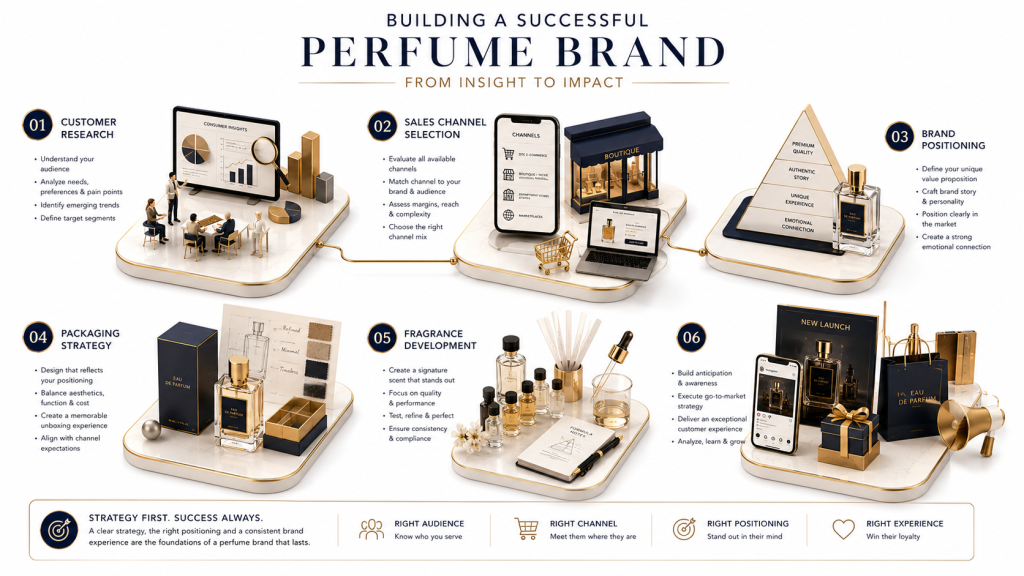
Once the appropriate market segment has been identified, the next step is creating a positioning strategy that is both coherent and difficult for competitors to replicate.
Create a Strong Brand Story
People remember stories far better than technical product features.
A compelling narrative helps create emotional connections and enhances differentiation.
The story may be based on:
- Founder values.
- Geographic origins.
- Cultural inspiration.
- A specific mission.
- A unique worldview.
The most important factor is authenticity.
Consumers can quickly recognize when a story feels artificial or disconnected from the brand.
Differentiate Emotionally
Perfume is an inherently emotional product category.
For this reason, successful fragrance brands often focus on creating emotional connections that extend beyond scent alone.
A useful question to ask is:
How do you want customers to feel when they interact with your brand?
The answer should influence everything from packaging design to marketing communication.
Design a Memorable Experience
Every interaction with the customer should reinforce the desired positioning.
This includes:
- Packaging.
- Website design.
- Customer service.
- Social media presence.
- Promotional materials.
- The purchasing process itself.
Each touchpoint contributes to the overall perception of the brand.
Align Product, Packaging, and Communication
One of the most common branding mistakes is inconsistency.
For example, a company attempting to position itself as a luxury fragrance brand will struggle if it uses generic packaging or low-quality communication materials.
Consistency is one of the most important drivers of trust and credibility.
The Relationship Between Positioning and Distribution
Positioning and distribution cannot be developed independently.
Both elements must reinforce one another.
Why Luxury Brands Cannot Sell Like Mass-Market Brands
Exclusivity depends heavily on scarcity and selectivity.
A luxury fragrance distributed through too many channels may lose part of its perceived value.
For this reason, many premium brands intentionally limit their points of sale.
Why DTC Brands Need a Different Value Proposition
When a company sells directly to consumers, it cannot rely on retailer validation.
Instead, it must build trust through:
- Strong storytelling.
- Excellent digital experiences.
- Effective marketing.
- Community engagement.
The direct-to-consumer model requires a distinctive positioning strategy that works independently of traditional retail environments.
How Distribution Influences Product Development
Distribution affects numerous product decisions, including:
- Bottle size.
- Target manufacturing costs.
- Packaging design.
- Customer experience.
- Promotional strategy.
This is precisely why the sales channel should be defined before fragrance development begins.
Questions You Should Answer Before Developing Your Perfume
Before starting any fragrance project, entrepreneurs should clearly answer the following questions:
Who Is My Ideal Customer?
Where Will I Sell My Products?
What Makes My Brand Different?
Why Should Consumers Choose My Brand?
What Problem Am I Solving?
How Will I Scale the Business Over Time?
The answers to these questions provide the strategic foundation for every subsequent decision.
Mistakes to Avoid When Launching a New Perfume Brand
Over the years, many fragrance projects have failed because they repeated the same strategic mistakes.
Some of the most common include:
Following Trends Without a Strategy
Trends change quickly.
Building a brand entirely around a temporary trend often creates long-term sustainability challenges.
Competing Only on Price
Lower prices may generate short-term sales, but they rarely build strong and profitable brands.
Trying to Sell to Everyone
Brands that attempt to appeal to every consumer often fail to create meaningful connections with any specific audience.
Developing the Perfume Before Validating the Market
Market validation significantly reduces risk and improves the chances of commercial success.
Failing to Calculate Margins Correctly
Many entrepreneurs discover too late that their cost structure is incompatible with their chosen distribution model.
Conclusion
Developing a fragrance is only one part of building a successful perfume brand. Before selecting fragrance notes, designing packaging, or planning production, it is essential to define how the product will reach the market and what position it will occupy within the competitive landscape.
A strong perfume distribution strategy influences pricing, margins, packaging, communication, and future growth opportunities. Likewise, clear fragrance positioning helps brands differentiate themselves, connect with the right consumers, and avoid competing solely on price.
The brands that achieve long-term success are not necessarily those with the best fragrance. They are the brands that understand their customers, identify real market opportunities, and build a coherent strategy from the very beginning.
At MS Parfum Lab, we help entrepreneurs, startups, and established companies develop private label fragrances based on a solid market strategy. From defining positioning and distribution channels to fragrance development, packaging design, and manufacturing, our team supports every stage of the process to maximize your brand’s chances of success.