Launching a perfume brand is an exciting venture that combines creativity, business strategy, product development, and flawless execution. However, one of the most common mistakes entrepreneurs and companies make when entering the fragrance industry is underestimating the time required to bring a product to market.
Many founders assume that creating a perfume simply involves choosing an appealing fragrance and designing attractive packaging. In reality, the process is far more complex. Behind every successful fragrance lies a structured development journey involving market research, fragrance creation, packaging design, regulatory compliance, manufacturing, and commercial planning.
This is where perfume project planning becomes essential. A well-structured perfume project plan helps reduce risks, optimize costs, and accelerate market entry without compromising product quality.
Although every project is unique, most perfume brands follow a series of common development stages. Depending on the level of customization, packaging complexity, and target markets, the entire process can take anywhere from three months to one year.
In this guide, we will explore the real timeline involved in launching a perfume brand, explaining how long each phase typically takes and which factors can influence project deadlines.
What Is Perfume Project Planning?
Perfume project planning is the process of organizing all the activities required to transform an idea into a market-ready fragrance product.
This process includes defining the brand concept, developing the fragrance, selecting packaging components, coordinating suppliers, managing regulatory documentation, overseeing production, and preparing for launch.
Effective planning enables multiple areas of the project to progress simultaneously. While the fragrance is being developed, for example, work can also begin on graphic design, packaging selection, and marketing strategy.
Without proper planning, delays, unexpected costs, and quality issues can arise, potentially jeopardizing the success of the project.
Why Is Proper Planning So Important?
Launching a perfume brand involves collaboration between numerous stakeholders, including perfumers, manufacturers, designers, packaging suppliers, laboratories, regulatory consultants, and commercial teams.
When there is no clear roadmap, common problems often include:
- Unexpected cost increases.
- Production delays.
- Documentation errors.
- Repeated work and inefficiencies.
- Continuous design changes.
- Supplier coordination challenges.
By contrast, a solid perfume project plan helps establish realistic objectives, define responsibilities, and anticipate potential issues before they impact the launch schedule.
Common Mistakes When Launching a Perfume Brand
Over the years, experienced perfume manufacturers have identified recurring patterns among projects that experience significant delays.
Some of the most common mistakes include:
Failing to Define a Budget Early
Without a clear financial framework, it becomes difficult to make consistent decisions regarding formulation, packaging, production volumes, and marketing investments.
Continuously Changing the Brand Concept
Every major change generates additional revisions, design adjustments, and delays throughout the development process.
Choosing Inexperienced Suppliers
The fragrance industry has specific technical and regulatory requirements that not all suppliers understand.
Underestimating Development Timelines
Creating a distinctive fragrance requires testing, validation, and approvals that cannot be rushed indefinitely.
Understanding these challenges from the beginning helps build a more efficient and sustainable launch strategy.
Phase 1: Defining the Brand Concept (1–3 Weeks)
Every successful perfume brand starts with a clear vision. Before developing fragrances or designing packaging, it is essential to define what the brand represents and who it is intended for.
This phase typically takes between one and three weeks, depending on the clarity of the initial concept.
Although some entrepreneurs try to rush this stage, investing sufficient time in strategic planning usually prevents many problems later in the project.
Identifying Your Target Audience
The first question every brand must answer is:
Who will buy this perfume?
The answer will influence virtually every decision that follows.
Developing a fragrance collection aimed at young consumers requires a completely different approach than creating a niche perfume line for high-income luxury buyers.
Common market segments include:
- Premium fragrances.
- Niche perfumery.
- Luxury perfumes.
- Sustainable fragrance brands.
- Trend-inspired perfumes.
- Corporate or personal branding fragrances.
Clearly defining the target audience enables the development of more relevant and competitive products.
Defining Your Brand Positioning
Once the ideal customer has been identified, the next step is creating a differentiated value proposition.
In a global market with thousands of fragrance references available, standing out has become increasingly challenging.
Key questions include:
- What makes the brand unique?
- What story does it tell?
- What emotions should it evoke?
- How should consumers perceive it?
Brand positioning serves as a guide for every decision related to product development, design, and communication.
Designing the Launch Strategy
During this stage, it is also advisable to define:
- Initial product range.
- Bottle sizes and formats.
- Target markets.
- Distribution channels.
- Pricing strategy.
For example, a brand that plans to sell exclusively online may adopt a very different strategy from a company focused on traditional retail distribution.
Making these decisions early simplifies production planning and budget forecasting.
Establishing the Project Budget
One of the most important aspects of perfume project planning is financial preparation.
The available budget will largely determine the level of customization possible in areas such as:
- Fragrance development.
- Packaging design.
- Premium finishing options.
- Minimum production quantities.
- Marketing campaigns.
- Promotional materials.
Defining a realistic investment range helps avoid unrealistic expectations and allows the project to move forward with a sustainable strategy.
Phase 2: Fragrance Development (4–12 Weeks)
Once the brand concept has been clearly defined, one of the most important stages begins: creating the fragrance itself.
This process typically takes between four and twelve weeks, depending on the complexity of the perfume and the number of revisions required.
Brands seeking a completely unique olfactory identity usually dedicate more time to this phase than those working with pre-existing fragrance bases.
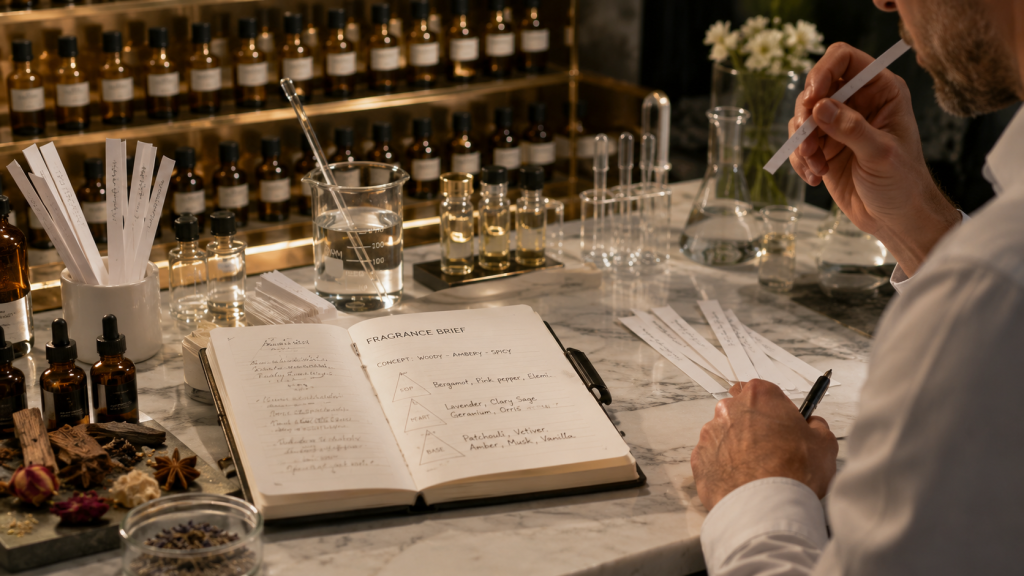
Creating the Fragrance Brief
Every fragrance development project starts with a detailed creative brief.
This document outlines the characteristics the perfume should possess and serves as the foundation for the perfumer’s work.
An effective fragrance brief may include:
- Perfume category.
- Target audience.
- Brand personality.
- Desired fragrance notes.
- Market references.
- Emotional objectives.
- Preferred intensity level.
The more detailed the brief, the more efficient the development process becomes.
Developing the First Samples
Based on the information provided, the fragrance laboratory creates several olfactory proposals.
These initial samples represent different interpretations of the brand concept.
In most projects, multiple alternatives are presented to facilitate comparison and decision-making.
Evaluating these samples is one of the most important moments in the entire development process.
Evaluating and Selecting Fragrance Proposals
Once the samples are received, the evaluation phase begins.
Fragrances should be tested under different conditions and at different times, since olfactory perception evolves throughout the wear experience.
It is important not only to evaluate the opening notes but also to assess the fragrance’s evolution, longevity, sillage, and consistency with the intended brand positioning.
Many companies gather feedback from different stakeholders before making a final decision.
Choosing the right fragrance at this stage can have a significant impact on future commercial success.
Fragrance Revisions and Final Approval
In most perfume development projects, the first sample presented by the laboratory does not immediately become the final product. It is common to make adjustments to refine specific aspects of the composition and ensure that the fragrance fully aligns with the brand’s vision.
Modifications may focus on several elements, including:
- Increasing or reducing the intensity of certain notes.
- Improving longevity on the skin.
- Achieving a better balance between top, heart, and base notes.
- Adapting the fragrance to a specific target audience.
- Creating greater differentiation from competing products.
Each revision cycle requires additional development time, preparation of new samples, and evaluation by the client. For this reason, excessive revisions are often one of the primary causes of delays in perfume brand launches.
Once the final formula has been approved, the project can move forward into packaging development, regulatory compliance, and production planning.
Phase 3: Packaging Design and Brand Identity (3–8 Weeks)
While the fragrance is being developed, many brands simultaneously work on their visual identity and packaging design.
This phase typically lasts between three and eight weeks, although it can take longer when fully customized bottles or premium finishes are involved.
Packaging plays a crucial role in the consumer experience. In many cases, the first interaction a customer has with a fragrance brand occurs through the bottle design and overall presentation.
Developing the Brand Identity
Before designing the packaging, it is essential to establish a consistent visual identity.
This typically includes:
- Logo design.
- Color palette.
- Typography.
- Photography style.
- Graphic elements.
- Brand messaging.
A strong visual identity helps create a professional and recognizable brand image.
Selecting the Bottle
The choice of bottle affects both product perception and manufacturing costs.
Brands generally have three options:
- Standard catalog bottles.
- Semi-customized bottles.
- Fully custom-designed bottles.
Projects that use standard packaging solutions often benefit from shorter development times and lower initial investment requirements.
By contrast, custom bottle development involves additional design, tooling, validation, and production stages.
Packaging Design
Beyond the bottle itself, brands must also develop secondary packaging and supporting materials.
Common packaging components include:
- Outer boxes.
- Labels.
- Silk-screen printing.
- Foil stamping.
- Premium finishing options.
- Promotional materials.
The objective is to create a presentation that aligns with the brand positioning and customer expectations.
Compliance with Packaging Regulations
Packaging must comply with the regulations of the target market.
Mandatory information may include:
- Product name.
- Net content.
- Responsible company details.
- Batch number.
- Ingredient list.
- Legal warnings.
Including these requirements from the beginning helps avoid costly revisions and production delays.
Phase 4: Regulatory Compliance and Documentation (2–6 Weeks)
Before a perfume can be sold, it must comply with all applicable legal requirements.
The duration of this phase depends on the target markets and the complexity of the project, but it typically takes between two and six weeks.
Product Safety Assessment
All cosmetic products sold within the European Union must undergo a safety assessment conducted by qualified professionals.
This evaluation analyzes:
- Complete formulation.
- Ingredient concentrations.
- Toxicological profile.
- Intended product use.
The purpose is to ensure that the perfume is safe under normal conditions of use.
IFRA Compliance
The International Fragrance Association (IFRA) establishes globally recognized standards for the safe use of fragrance ingredients.
Compliance with IFRA guidelines is essential for consumer safety and international market acceptance.
Preparing Technical Documentation
Every perfume must be supported by comprehensive technical documentation.
This documentation typically includes:
- Qualitative and quantitative formula details.
- Safety assessment reports.
- Raw material certificates.
- Manufacturing information.
- Regulatory compliance records.
Proper documentation management reduces legal risks and facilitates future audits or inspections.
Market-Specific Requirements
Different regions may have unique regulatory requirements.
European Union
Harmonized cosmetic regulations and product notification procedures.
United Kingdom
Independent regulatory requirements following Brexit.
United States
Different standards regarding labeling and cosmetic product claims.
Middle East
Specific registration procedures and market authorization requirements.
Planning international expansion from the beginning can save considerable time and resources later in the project.
Phase 5: Production Planning and Procurement (4–10 Weeks)
Once the fragrance and packaging have been approved, attention shifts to securing all materials required for manufacturing.
This phase generally takes between four and ten weeks, depending on component availability and supplier lead times.
Ordering Bottles and Components
Materials commonly required include:
- Glass bottles.
- Caps.
- Spray pumps.
- Folding cartons.
- Labels.
- Promotional materials.
The availability of these components directly impacts the launch schedule.
Managing Packaging Suppliers
Effective coordination between manufacturers and suppliers is essential to avoid production interruptions.
Delays involving a single packaging component can affect the entire project timeline.
Inventory Planning
Accurate forecasting helps prevent two common issues:
- Product shortages during launch.
- Excess inventory tied up in storage.
Production quantities should be based on realistic sales objectives and a clearly defined distribution strategy.
Minimizing Supply Chain Risks
Experience shows that many delays originate from logistical challenges.
To reduce risk, brands should:
- Confirm lead times in writing.
- Work with reliable suppliers.
- Build safety margins into schedules.
- Develop backup sourcing options whenever possible.
Phase 6: Perfume Manufacturing (2–6 Weeks)
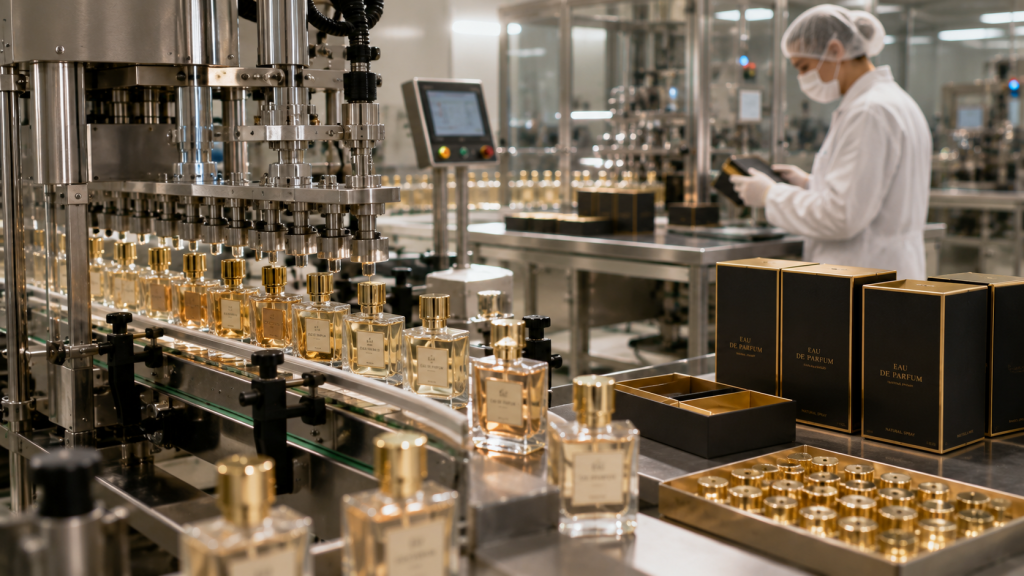
Once all components are available, manufacturing can begin.
Depending on production volume and project specifications, this stage generally takes between two and six weeks.
Fragrance Production
Manufacturing starts with the preparation of the fragrance concentrate according to the approved formulation.
Precision at this stage is critical to ensure consistency across production batches.
Maceration and Stabilization
Many perfumes require a maceration period that allows fragrance ingredients to blend and mature properly.
This process contributes to improved stability and olfactory performance.
Filling and Assembly
Once the fragrance is ready, production continues with:
- Bottle filling.
- Pump installation.
- Cap assembly.
- Label application.
- Final packaging.
Each stage must follow strict quality control procedures.
Quality Control
Before products are released for distribution, several quality checks are performed, including:
- Visual inspection.
- Packaging integrity.
- Spray pump functionality.
- Label verification.
- Product stability testing.
These controls help identify potential issues before products reach consumers.
Phase 7: Preparing for Market Launch (2–4 Weeks)
While production is being completed, brands should prepare all commercial activities required for a successful launch.
This stage typically takes between two and four weeks.
E-Commerce Development
Many modern fragrance brands begin by selling directly through online channels.
The website and online store should be fully operational before inventory becomes available.
Product Photography and Visual Content
Professional imagery is essential for communicating quality and building consumer trust.
Typical content includes:
- Product photography.
- Lifestyle images.
- Promotional videos.
- Social media content.
Digital Marketing Strategy
Marketing activities may include:
- Social media campaigns.
- Paid advertising.
- Email marketing.
- Influencer partnerships.
- Public relations initiatives.
A well-executed launch strategy can significantly improve early sales performance.
Retailers and Distribution Partners
Brands planning to enter physical retail channels should begin discussions with distributors and retailers well before production is completed.
Having commercial agreements in place before inventory arrives can accelerate market penetration.
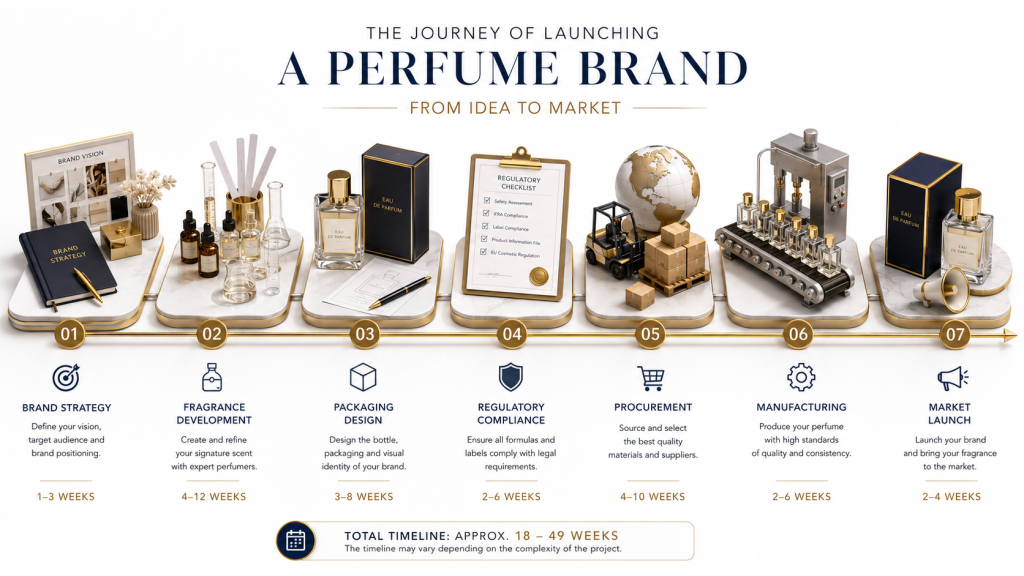
Realistic Perfume Brand Launch Timeline
Although every project is unique, the following timeline reflects a typical perfume development process:
| Phase | Estimated Duration |
| Brand Concept Development | 1–3 Weeks |
| Fragrance Development | 4–12 Weeks |
| Packaging Design | 3–8 Weeks |
| Regulatory Compliance | 2–6 Weeks |
| Procurement and Sourcing | 4–10 Weeks |
| Manufacturing | 2–6 Weeks |
| Launch Preparation | 2–4 Weeks |
Fast-Track Launch: 3–4 Months
Possible when using stock packaging, streamlined processes, and rapid decision-making.
Standard Launch: 6–8 Months
The most common scenario for independent fragrance brands seeking quality and differentiation.
Premium Launch: 9–12 Months
Typical for projects involving bespoke fragrance development, custom packaging, and international distribution.
Factors That Can Delay a Perfume Launch
Even with excellent planning, several factors can impact timelines:
- Continuous fragrance modifications.
- Packaging redesigns.
- Supplier delays.
- Regulatory issues.
- Component shortages.
- Inaccurate production forecasting.
Identifying these risks early allows brands to minimize their impact and maintain momentum throughout the project.
How to Reduce Time to Market Without Compromising Quality
Brands that launch successfully and efficiently often share several common characteristics:
- They define clear objectives from the start.
- They work with experienced perfume manufacturers.
- They centralize project management.
- They implement efficient approval processes.
- They develop marketing activities in parallel with product development.
Working with a full-service perfume manufacturer can significantly simplify coordination and accelerate project execution.
Conclusion
Launching a perfume brand involves far more than creating an appealing fragrance. Success depends on careful planning that integrates product development, design, regulatory compliance, manufacturing, and commercial strategy.
While some projects can reach the market within a few months, most successful fragrance brands require six to eight months to launch with the quality, consistency, and competitiveness needed to succeed.
Understanding the real perfume project planning timeline helps entrepreneurs establish realistic expectations, optimize resources, and avoid unnecessary delays.
If you are planning to launch your own fragrance collection, partnering with an experienced manufacturer can make the difference between a complicated development process and a successful market launch.
At MS Parfum Lab, we help entrepreneurs, startups, and established companies develop and manufacture private label perfumes, guiding every stage of the process—from the initial concept and fragrance creation to production and market launch.